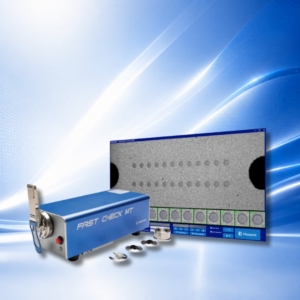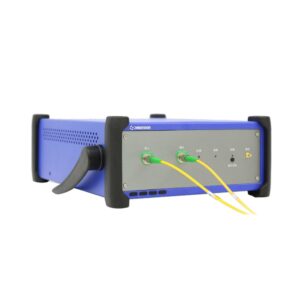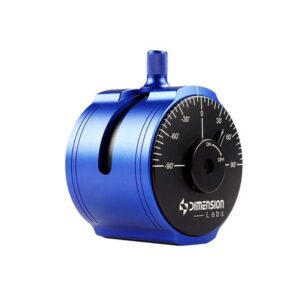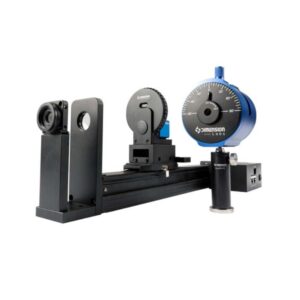
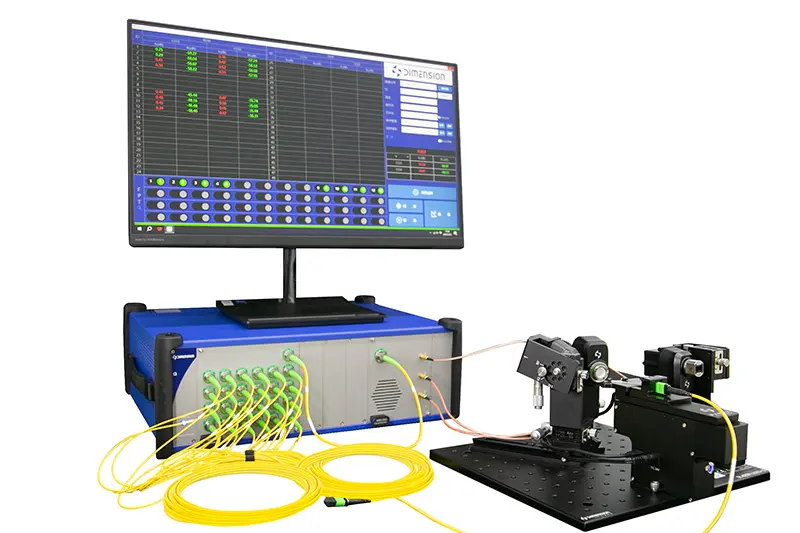
FA MAX MT-FA Test Solution
One-step detection of IL, RL, and polarity, solving FA polarity issues.
- Support SM/MM FA test
- Customized wavelength
- IL,RL,Polarity 3 in one
- Special mode for FA,higher accuracy for RL
- Patented visual detection polarity
- Rich FA fixture,interface,easy to replace
- Optional external PD for muti-branch FA/Z-BLOCK
- Can be upgraded in the existingpolarity insertion loss meter
- Integratingball can be customized to test 2000+core number FA
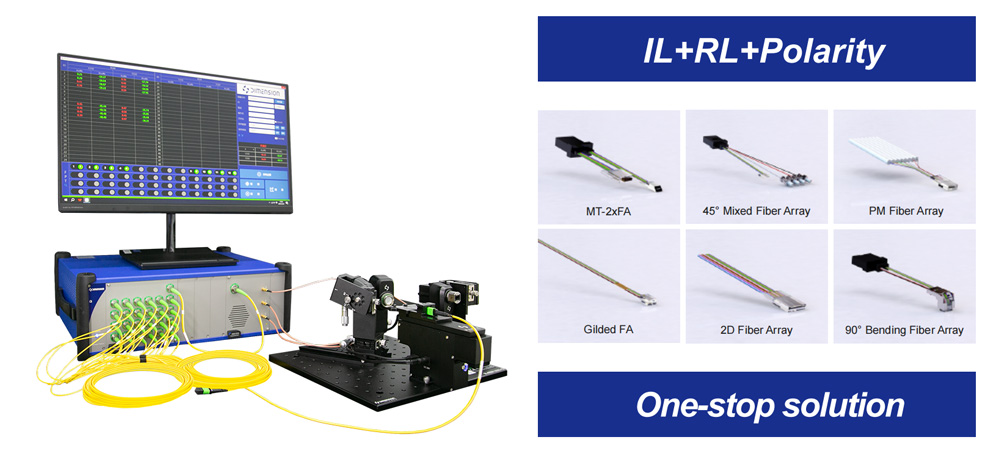
Product Overview
MT-FA with the development of optical modules also ushered in new market demand.Different from the traditionalconnector, the crystal end face at the end of MT-FA cannot be directly physically connected, and the length of the deviceis generally short, so there are problems such as light leakage and inaccurate return loss test, and the polarity of fibercannot be tested with conventional polarity detector.Dimension Technology upgrades and iterates on the basis oimulti-core polarity insertion loss instrument to provide customers with a one-stop FAUMPER test solution, taking intoaccount the FA test of different branches and diferent angles, improving the eficiency of production inspe ction.
Main advantages
· Support SM/MM FA test
· Customized wavelength
· IL,RL,Polarity 3 in one
· Special mode for FA,higher accuracy for RL
· Patented visual detection polarity
· Rich FA fixture,interface,easy to replace
· Optional external PD for muti-branch FA/Z-BLOCK
· Can be upgraded in the existingpolarity insertion loss meter
· Integratingball can be customized to test 2000+core number FA
Main applications
· MT-FA
· JUMPER
· Z-BLOCK
Main Feature
· Varible programmble functions
· For Tx IL、ISO,Rx IL、RL
· Base on OMEGA platform
Rich interface design, stable clamping, multi-dimensional optical parts fine tuning
Traditional insertion and return loss meters often face interface issues when testing FA devices, causing light leakage and inaccurate measurements. Dimension Technology’s clamp and interface design ensures quick, stable operation, prevents scratches, and reduces errors.
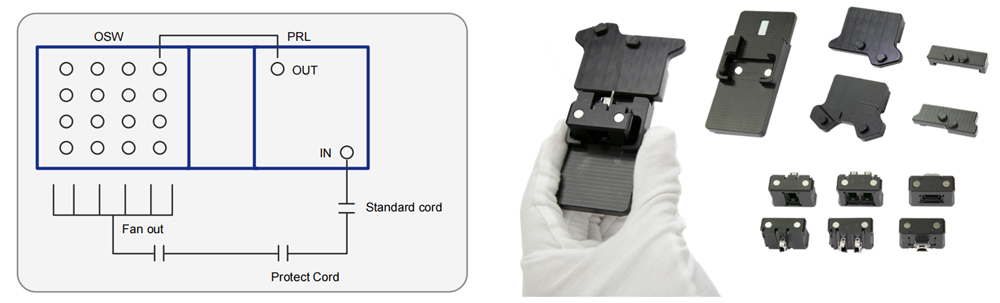
To accommodate wider FA or multiple branch ports, the insertion and return loss meter’s integrating sphere now has a >10mm light entry aperture with a light leakage prevention design.
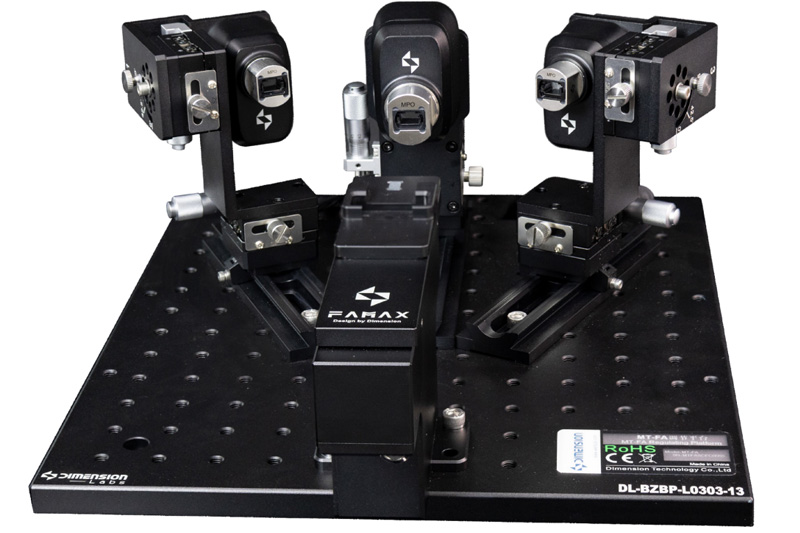
For MT-FA testing, Dimension Technology offers a multi-dimensional adjustable optical platform for simultaneous multi-port testing, easily adjustable for different devices.
One-step detection of IL, RL, and polarity, solving FA polarity issues
FA/JUMPER devices cannot connect to the MPO interface ofpolarity testers, making TOSA/ROSA array testing ineffective.
Dimension Technology’s patented visual polarity detection solves this problem. Integrated into the insertion and return loss meter, it enables one-step IL, RL, and polarity testingfor FA/JUMPER devices.
This testing solution can automatically test IL, RL, and polarity. For high-fiber-count arrays (2000+fibers), it uses a high-capacity integrating sphere. For multi-branch FA devices, the softwareintelligently organizes polarity sequences and generates a unified report.
Optimized return loss testingfor FA/JUMPER connectors
Non-wrapped return loss meters, based on OTDR principles, have blind spots when testina uitra-short connectorswithout special handling. Wrapped return loss meters using OcWR also fail to test MT-FA device Rx end MT returnoss without matching gel. Dimension Technology has optimized the OTDR algorithm for FA-specific scenariosenabling detection of Rx end MT return loss.
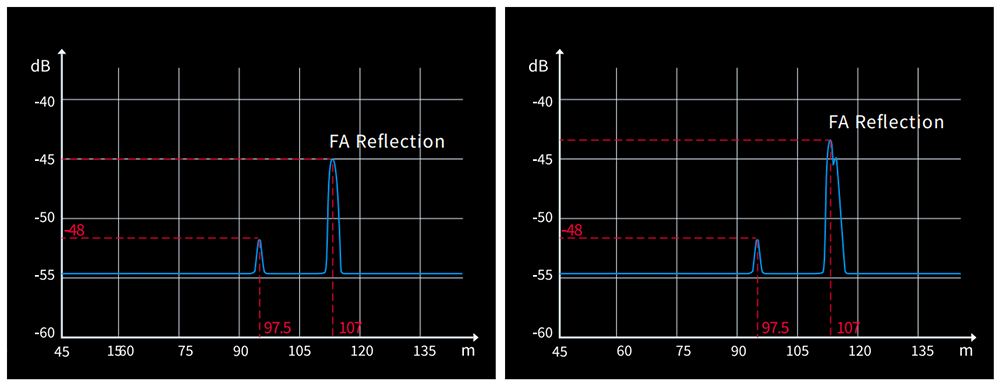
Based on the optimized algorithm of Dimension Technology’s multi-core polarity insertion and return loss meter the MT end return loss test results are stable and accurate when using
Main Specifications

*Return loss accuracy: For optical power levels below -60dB, the error increases by t0.1dB for every 1dB decrease in power.
Ordering Information

Example:
RLM1612A-1FA-24 24-Core Polarized Non-Wraped inserion Loss Meter, Wavelength 1310/1550, $ingle Mode 9/125 InGaAs 2mm (Polanized integraing sphere), ightSource Output Port 1CH, Interface Type FC/APC
Note:
Model AC supports dualaser wavelengths.The two digt code represents the wavelengths ofthe wo lasers, and customers can selecthe laserwavelengths from the ist orcustomize them.Model B supports 4 single-mode wavelengths, and the laser wavelength must be selected as XX.