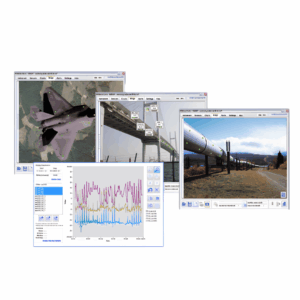
The 3DViz software provides intuitive 2D and 3D visualization of high-definition sensor data. The software allows strain or temperature data from an ODiSI system to be visualized directly on a 3D CAD model or a 2D image.
The T-Ray® 5000 is ideally suited for spectroscopic investigations. With its exceptionally long high speed delay, the T-Ray® 5000 can provide spectral resolution down to 1.5 GHz at 100 Hz. The measurement system is robust enough to be deployed in an industrial environment, but flexible enough to be used for a wide variety of experimental tasks.
The T-Ray® 5000 is the first compact pulsed terahertz measurement system that is robust enough to be deployed in an industrial environment and has all of the flexibility provided by our fiber coupled sensor heads in a rack mount package. By having replaceable sensor heads, the T-Ray® 5000 can be configured to fit your specific application.
Unlike conventional strain gages that only measure strain at a discrete point, Luna’s high definition fiber optic strain gages provide continuous, high-resolution (less than 1 mm) measurements of strain along the entire length of the sensor. Sensors are now available in lengths up to 100 m.
The high-definition strain-compensated (HD-SC) temperature sensors are low-profile, flexible sensors incorporating advanced strain compensation technology to deliver more accurate and reliable temperature data when surface-mounted or embedded.
Unlike conventional discrete temperature sensors, Luna’s high definition fiber optic temperature sensors provide continuous, high-resolution (less than 1 mm) measurements of temperature along the sensor fiber.
LUNA
HD6T – High-Definition Fiber Optic Temperature Sensors
HD temperature sensors are low-profile versatile fiber optic sensors which, when used with an ODiSI system, can provide more than a thousand distinct temperature measurements per meter. HD temperature sensors consist of polyimide coated fiber housed loosely in a PTFE tube (jacket) to reduce the amount of strain applied to the sensor.
The continuous fiber grating (CFG) sensor expands high-definition (HD) fiber optic sensing applications for the ODISI with more robust and reliable operation in dynamic environments. CFG Sensors provide a gage pitch of 6 mm and are available in lengths up to 15 m.
LUNA
HDCFG : HD Continuous Fiber Grating (CFG) Sensors
CFG strain sensors are low-profile versatile fiber optic sensors which provide improved immunity to vibration and higher bandwidth of measurement. Compatible with ODISI 6000 and 6100 systems and standard remote modules, CFG sensors provide a valuable alternative for more dynamic environments.
Operating in reflection or transmission mode, the fiber-coupled HRS40n1 sensor heads deliver a picosecond duration time-domain terahertz pulse, allowing high speed, scanned images to be
easily produced with the T-Ray 5000 system.
The HTS40n1 is a transmitter for the T-Ray® 5000, the first compact pulsed terahertz measurement system that is robust enough to be deployed in an industrial environment and has all of the flexibility provided by our fiber-coupled sensor heads in a rack mount package.
The HTS40n2 Transmitter Type 2 for the T-Ray® 5000 balances high output power with high spectral bandwidth and minimizes features following the pulse to allow high quality images and detection of multiple layers in reflection with less need for post processing of the waveform.
The T-Gauge® is the first compact pulsed terahertz measurement system that is robust enough to be deployed in an industrial environment and has all of the flexibility provided by our fiber coupled sensor heads in a rack mount package. By having replaceable sensor heads, the T-Gauge® can be configured to fit your specific application.
The HXP51y2 Online EPG Sensor Head allows measurement of thinner layers than the standard HXC55yn Online Sensor Head. With higher bandwidth, and higher signal to noise, the EPG opens new applications to terahertz process control.
In order to provide you a personalized shopping experience, our site uses cookies. By continuing to use this site, you are agreeing to our cookie policy.